
What Could We Automate? · Episode 03
Where Did We Store Those Tires?
Discover how a real-world custom application connects customer records, tire storage locations, pickup scheduling, and installation workflows to help an automotive business manage seasonal tire storage efficiently.
By Walker Small Business Solutions
# What Could We Automate? — Episode 03
# Where Did We Store Those Tires?
*How a custom application connected seasonal tire storage, rack locations, pickup scheduling, and installation workflows.*
**A real-world application — developed and still in use today.**
The Challenge: Hundreds of Tires, One Simple Question
For an automotive service business offering seasonal tire storage, managing customers' tires involves much more than finding space on a rack.
Every stored set belongs to a particular customer and vehicle. The tires need to be identified, their condition recorded, and their physical location documented.
Months later, when the customer returns for a seasonal tire change, staff need to find the correct set, retrieve it, and have it ready for installation.
As a storage operation grows, keeping that information organized becomes increasingly important.
A misplaced set, an outdated storage location, or an unclear pickup schedule can turn a routine tire change into an unnecessary search.
**Where did we store those tires?**
It's a simple question, but answering it reliably requires connecting several parts of the business.
A Custom Application Built for the Job
Wheels Warehouse was developed to manage these specialized operations.
The application was originally created and it remains in use today.
Rather than forcing the storage process into a generic inventory application, the software was designed around the actual work performed by an automotive service business.
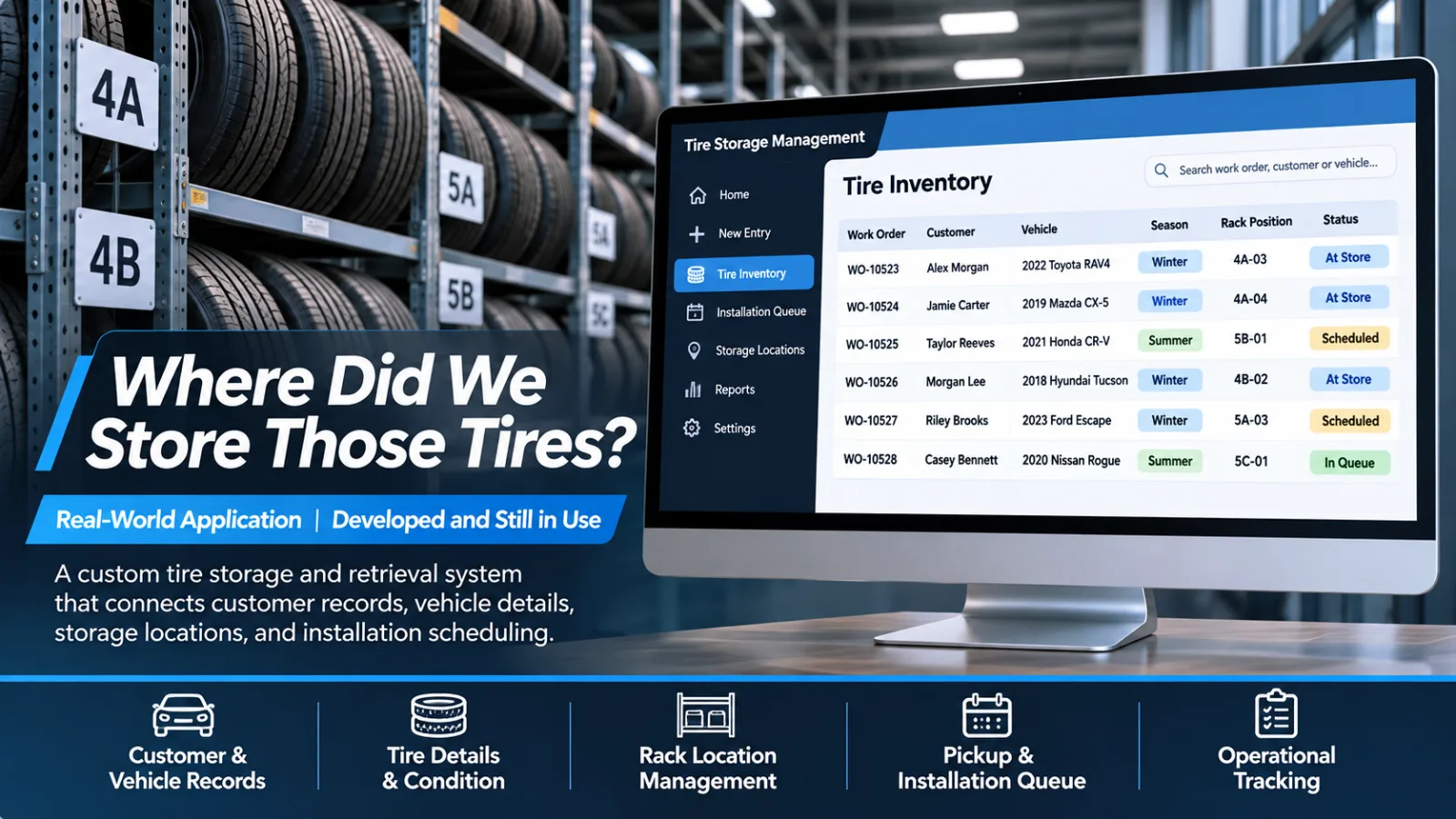
It connects customer and vehicle information, tire details, work orders, storage locations, and pickup scheduling within a single operational system.
Staff can identify a stored tire set by searching for the customer, vehicle license plate, or work-order number.
The application provides the recorded storage location and operational status, helping staff determine where the tires are and whether they have been scheduled or pulled for retrieval.
From Customer Intake to Storage
When a new tire set arrives, staff create a storage record associated with the customer's work order.
The record can include:
- Customer and vehicle information.
- Tire make, model, and size.
- Individual tire tread measurements.
- Tire condition notes and photographs.
- Seasonal storage information.
- Storage dates and scheduled pickup details.
A printable identification label connects the physical tire set to its corresponding business record.
Once the tires are ready for storage, staff assign a rack position.
The location becomes part of the stored record, allowing staff to find the set without relying on memory or manually maintained location lists.
**One record connects the customer, vehicle, tires, and physical storage location.**
Making Retrieval More Organized
The value of organized storage becomes particularly apparent when seasonal tire changes begin.
Instead of searching through individual customer records to determine which tires need to be retrieved, staff can use a pickup list based on scheduled dates.
The application organizes eligible tire sets by storage position, making it easier to prepare multiple sets for upcoming appointments.
Staff can print a pickup checklist and record when individual tire sets have been pulled.
Once retrieved, the application updates their operational status and moves them into the next stage of the workflow.
The installation queue allows staff to identify pending work and record installation completion.
This connects the physical movement of tires with the work taking place in the shop.
More Than Just Inventory Tracking
A conventional inventory system generally focuses on product quantities.
Seasonal tire storage is different.
Each tire set belongs to a specific customer and vehicle, has its own condition information, occupies a particular location, and must be retrieved for a future service appointment.
The application brings these relationships together.
It also supports operational features such as storage paperwork, printable labels, tire condition photographs, and staff-initiated customer messaging.
Where compatible integrations are configured, customer and vehicle details can be retrieved from existing automotive shop management systems, reducing the need to enter the same information more than once.
The result is an application organized around a specialized business process rather than a generic collection of inventory records.
Built for a Real Business. Still in Use Today.
Wheels Warehouse is an example of software developed to address a genuine operational requirement.
Its value lies in connecting information that would otherwise have to be managed across separate records, documents, and manual processes.
This is the type of opportunity Walker SBS looks for: understanding how a business operates and identifying where custom software could make its processes more manageable.
The solution doesn't have to be a large enterprise platform.
Sometimes the most useful application is one designed to solve a particular problem exceptionally well.
Where Else Could This Approach Work?
Although Wheels Warehouse was developed for seasonal tire storage, the underlying concepts apply to many other businesses.
Consider a company managing tools, specialized equipment, rental assets, or warehouse inventory.
Each item may need to be identified, associated with a customer or job, assigned a location, and tracked through an operational workflow.
A custom application could connect those activities into a system tailored to the company's requirements.
For example:
- A contractor tracking tools and equipment across job sites.
- A rental company organizing equipment availability and returns.
- A warehouse managing specialized customer-owned inventory.
- A service business maintaining stored parts and equipment.
- A distributor coordinating storage locations and order preparation.
These are potential applications of the same approach, not features of Wheels Warehouse itself.
Software Built Around Your Business
Not every business problem has an off-the-shelf solution.
And not every business should have to change its operations to accommodate the software it uses.
At **Walker Small Business Solutions**, we develop custom applications that connect business information, support operational workflows, and address the practical challenges businesses encounter every day.
**What's one process in your business that existing software doesn't handle particularly well?**
Contact Walker SBS to explore how a purpose-built application could work for your operations.
Could something like this improve your business?
Explore our custom business software and workflow automation services, including system integration. See how we scope and build an application, then contact Walker SBS to discuss your operations.
Contact Walker SBS